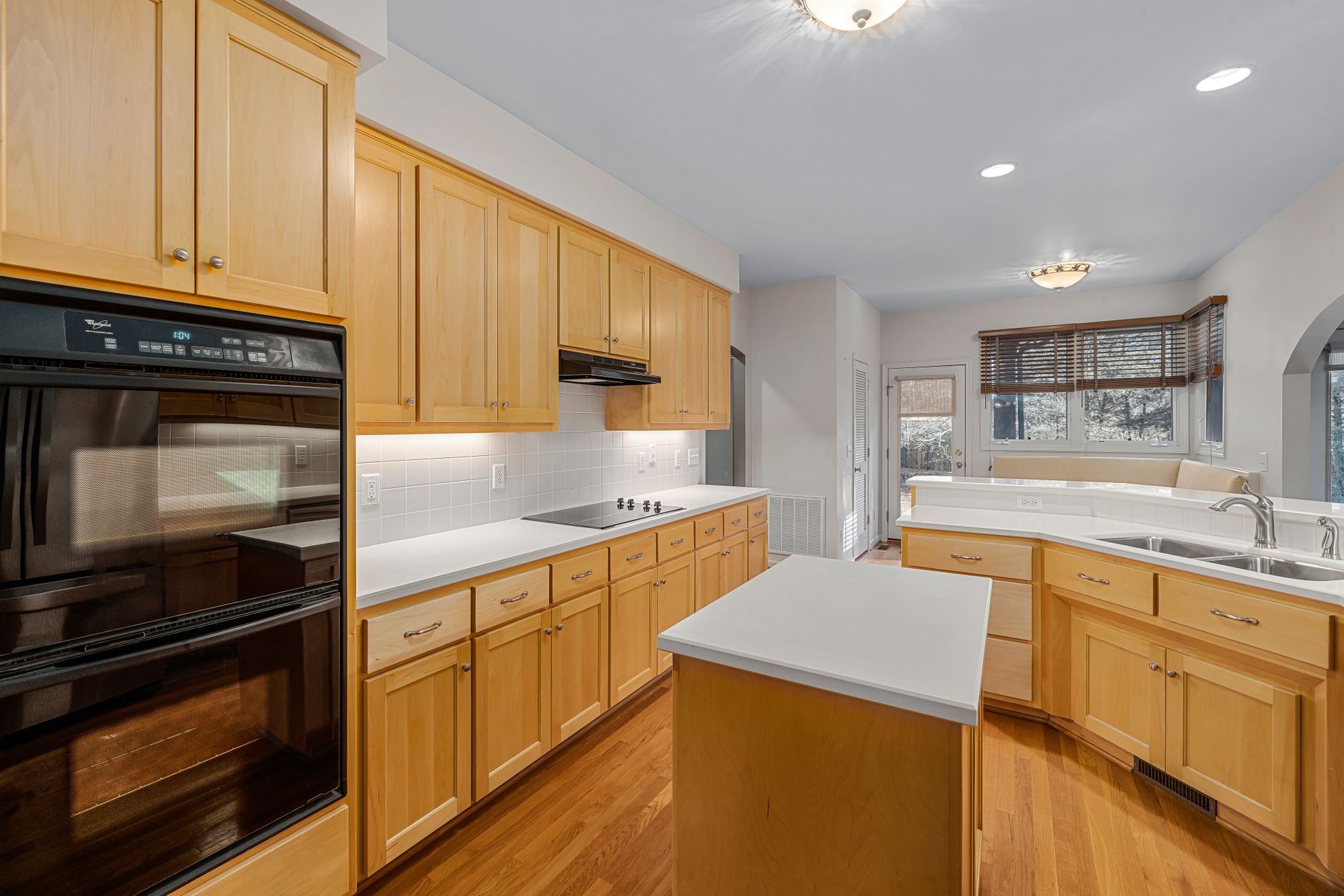
Ask two cabinet showrooms the same question and you will get two different vocabularies. One talks about face frames and overlay. The other talks about full access and European construction. They are describing the same fundamental split, and it is the decision that quietly determines how much of your kitchen you can actually reach.
Framed or frameless is not a style choice, although it gets presented as one. It is a structural difference with practical consequences you will notice every single day.
The two constructions
A framed cabinet is a box with a hardwood frame fixed to the front edge, like a picture frame, usually about an inch and a half wide. The doors hang off that frame and the frame carries the load. This is the traditional North American method and it has been the default here for a very long time.
A frameless cabinet has no front frame. The box is built from thicker panels, typically three quarter inch, and the doors mount directly to the side panels with concealed hinges. The box itself has to be stiffer because there is no frame stabilising the front. This is the standard European method and it has been steadily gaining share.
Everything else follows from that one difference.
What the frame costs you in usable space
The frame sits in front of the opening, which means the opening is smaller than the box behind it. On a typical framed base cabinet, the frame reduces the clear opening by around an inch and a half on each side.
That does not sound like much until you try to get a stock pot out of a base cabinet, or until you specify drawers. A drawer box has to fit through the opening, not the box, so a framed cabinet holds narrower drawers than a frameless cabinet of the same external width. Across a run of five base cabinets, the difference in usable drawer volume is significant.
The frame also creates a lip at the bottom of the opening on base cabinets. Pulling a heavy roasting tin out of a framed cabinet means lifting it over that lip. Out of a frameless cabinet it slides straight out. Anyone who has emptied a lower cabinet on their knees understands why this matters.
Frameless construction gives you somewhere in the region of ten to fifteen percent more accessible storage in the same footprint. In a small kitchen where the footprint is fixed, that is the cheapest storage you will ever buy.
What the frame buys you
It is not all one way, and the frame has genuine advantages.
Rigidity is the main one. A face frame makes the box very stiff, which means a framed cabinet tolerates an imperfect installation better. Set a framed cabinet on a floor that is slightly out and the frame holds the opening square. A frameless cabinet in the same position can rack slightly, and because the doors mount to the box, a racked box shows up immediately as a door that will not line up.
This has a direct consequence for who should install them. Frameless cabinetry demands a level, plumb, carefully shimmed installation, and it punishes shortcuts visibly. Framed cabinetry is more forgiving. When people say frameless cabinets are only as good as the installer, this is what they mean, and it is why a local Yakima cabinet installation crew accustomed to older houses with settled floors will often have strong opinions on the subject.
The frame also supports certain traditional door styles properly. Inset doors, which sit flush within the frame rather than overlaying it, are the most refined looking cabinet door there is, and they essentially require a frame to sit inside. If you want a period kitchen, framed is the correct answer.
Repair and modification are easier too. A frame gives you something to scribe against at a wall, something to attach a filler strip to, and something solid to plane if a door needs adjusting.
Overlay, and why the terminology confuses everyone
On a framed cabinet, how much of the frame the door covers is called the overlay.
Standard or partial overlay leaves a visible band of frame between doors, typically an inch or more. It is the least expensive and it looks distinctly traditional, in a way that reads as dated to some people and as classic to others.
Full overlay covers almost the entire frame, leaving only a narrow reveal between doors. It looks very close to frameless from the outside while keeping the frame behind. It costs more because the doors are larger and the tolerances tighter. For most people who like the clean look but are working with an older house, this is the practical middle.
Inset sits the door inside the frame, flush with it. It is the most expensive, the most beautiful, and the most sensitive to seasonal wood movement, because a door that fits perfectly in a dry winter can bind in a humid summer.
Frameless cabinets are effectively always full overlay, since there is no frame to reveal.
The hardware difference
Frameless cabinetry grew up alongside the thirty two millimetre system, a standardised grid of holes drilled up the inside of each side panel. Shelves, hinges and drawer runners all locate on that grid.
The practical benefit is flexibility. Shelves move in fine increments. Drawer runners mount directly to a flat side panel, which means full extension soft close runners fit without adaptation and the drawer runs the full internal width.
On a framed cabinet, drawer runners have to be packed out to clear the frame, using a bracket or a rear socket. This works perfectly well and has for decades. It is simply more parts, slightly more expense, and a narrower drawer.
Hinges differ similarly. Frameless uses a straightforward concealed hinge cup. Framed uses either a face frame specific concealed hinge or a traditional exposed hinge, which is a legitimate design feature in its own right.
Cost, and why the comparison is slippery
Frameless is often described as more expensive, and just as often as cheaper. Both claims appear because people are comparing different things.
A frameless box uses more material, because the panels are thicker and there is no frame doing the stiffening. That pushes the box cost up. But it uses less labour, because there is no frame to build, join and attach, and it is better suited to automated manufacturing.
A framed box uses less sheet material and more hardwood, and it takes more assembly steps.
The net effect is that at the budget end, framed is usually cheaper, because inexpensive framed cabinetry can use thin material behind a frame that hides it. At the higher end the two converge, and the price is driven by the door, the finish and the hardware rather than by the construction method.
Which means construction should not really be a budget decision at all. Decide it on the two questions that follow, and let the specification move to meet the budget.
How to actually decide
Start with the house. A period home with plaster walls, a settled floor and existing trim will usually look right in framed cabinetry, and the installation will go more smoothly. A newer or renovated space with square walls will take frameless without a fight.
Then look at the kitchen size. If storage is tight and the footprint cannot grow, the extra usable volume from frameless is a real functional gain rather than a marginal one.
Then consider the door style you actually want. If it is inset, that decides it. If it is a slab or a simple shaker in full overlay, both constructions can deliver it and you should choose on the other factors.
Finally, be honest about the installation. Frameless is not harder to build, it is harder to install well, and the quality of the crew matters more. If you are confident in the installer, that concern disappears. If you are choosing on price alone from an unknown outfit, framed leaves you less exposed.
Both constructions, built properly from good materials, will outlast the appliances around them. The difference is in how much you can reach, how the doors sit, and how much the installation has to get right.
Need help in Yakima?
Call (509) 627-8150